KEP-4420: Retry Generate Name
KEP-4420: Retry Generate Name
- Release Signoff Checklist
- Summary
- Motivation
- Proposal
- Design Details
- Production Readiness Review Questionnaire
- Implementation History
- Drawbacks
- Alternatives
- Infrastructure Needed (Optional)
Release Signoff Checklist
Items marked with (R) are required prior to targeting to a milestone / release.
- (R) Enhancement issue in release milestone, which links to KEP dir in kubernetes/enhancements (not the initial KEP PR)
- (R) KEP approvers have approved the KEP status as
implementable - (R) Design details are appropriately documented
- (R) Test plan is in place, giving consideration to SIG Architecture and SIG Testing input (including test refactors)
- e2e Tests for all Beta API Operations (endpoints)
- (R) Ensure GA e2e tests meet requirements for Conformance Tests
- (R) Minimum Two Week Window for GA e2e tests to prove flake free
- (R) Graduation criteria is in place
- (R) all GA Endpoints must be hit by Conformance Tests
- (R) Production readiness review completed
- (R) Production readiness review approved
- “Implementation History” section is up-to-date for milestone
- User-facing documentation has been created in kubernetes/website, for publication to kubernetes.io
- Supporting documentation—e.g., additional design documents, links to mailing list discussions/SIG meetings, relevant PRs/issues, release notes
Summary
This enhancement proposes that create requests using generateName are retried automatically by the API server when the generated name conflicts with an existing resource name.
Motivation
Kubernetes generates a 5 char random suffix that is appended to a prefix specified by .metadata.generateName.
Each char in the sequence is from the “bcdfghjklmnpqrstvwxz2456789” range.
This leads to $27^5 = 14,348,907$ possible names per generateName prefix. For
context, we have seen clusters store 100,000..1,000,000 custom resources, so the total
number of names that can be generated is not currently a problem.
But there is a problem with name conflicts. There is a 50% chance of hitting a conflict before generating even 5000 names, and a 0.1% chance at only 500 names!
Today a HTTP 409 respose returned to the client if a name conflict happens. It is possible for clients to detect the error and retry, but we’ve seen that most clients don’t realize to do this and hit this problem in production.
Goals
- Reduce probability of generated name conflicts to below 0.1% for up to 1
million generated names per
generateNameprefix.
Non-Goals
- Change the length of the random suffix. This is a breaking change:
- There is a 63 char name length limit. to guarantee a 5 char random suffix
length,
generateNameis trimmed if its length is >58 chars. If the random suffix length were to be increased,generateNamewould need to trimmed to a shorter length, breaking users that depend on 58 chars ofgenerateNamebeing preserved. (Increasing the max length ofnamewould also be a breaking change). - There are major downstream projects that use regular expressions with a
{5}exact match count that is intended to match the random suffix.
- There is a 63 char name length limit. to guarantee a 5 char random suffix
length,
- Eliminate the possibility of generated name conflicts entirely. This is
much harder problem given that
generateNamedoes create names in a reserved identifier space, and so any mechanism to pick names is prone to conflicts.
Proposal
Modify the apiserver to retry name generation. When performing the create operation at the storage layer of the kube-apiserver, if the create fails with a “name conflict” error, generate a new name and retry.
If we retry up to 7 times, we can generate up to 1 million names before reaching a 0.1% chance of a collision. This is roughly the same probability of collision we would get if we were to increased the number of chars per random generateName suffix to 11.
While this doesn’t eliminate the possibility of name conflicts when very large
numbers of resources are generated with the same generateName prefix, it does
effectively eliminate name conflicts for more typical use cases. When generating
<=100,000 resources with a single generateName prefix, there is a 1 in
$1.6x10^{13}$ chance of ever encountering a name conflict.
Risks and Mitigations
This approach results in reinvocation of validating admission for each generated name attempted. This can impact request latency when validating webhooks are involved.
We do not believe this is a problem in practice because we expect this to be very rare. For example, for a validating webhook that takes 1 second to respond, and requires the maximum number of retries (7). This still results in only 7 second of additional latency. In practice most webhooks respond much faster and the number of retries is expected to be lower.
Note also that the alternative to retrying the create from the apiserver is to return an error to the client. And even if the client realizes to retry the request, it will take even longer from the client to perform the retry.
Design Details
That the probability of a name conflict follows normal hash collision probabiblities:
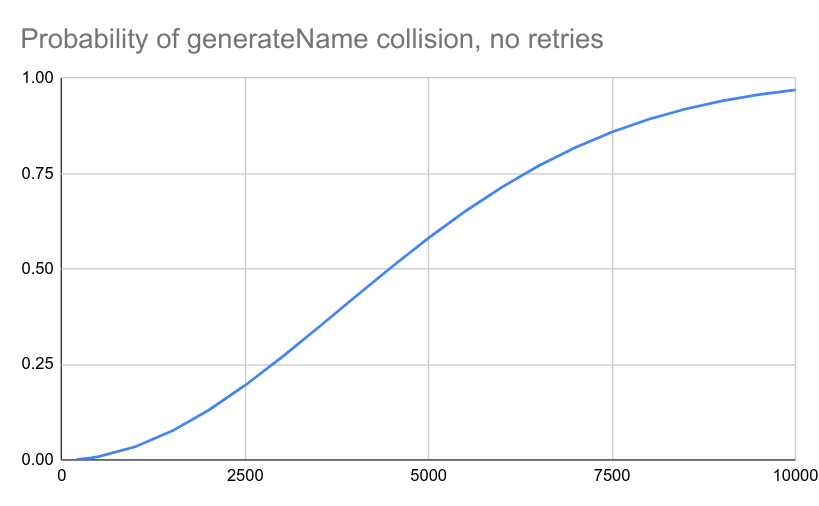
The probability decreases dramatically if we retry when a generated name conflicts with an existing name. We can calculate the probability when retries are performed iteratively with:
$C_n=C_{n-1}+(1-C_{n-1})(n-1/N)^t$
Where $C_n$ is the probablity of a name conflicts when creating $n$ names,
$N$ is the total number of names, $t$ is the number of tries performed to
find a non-conflicting name before the attempt is considered a conflict.
Graphing this out for $t=2$ highlights how much better this is than what we have today:
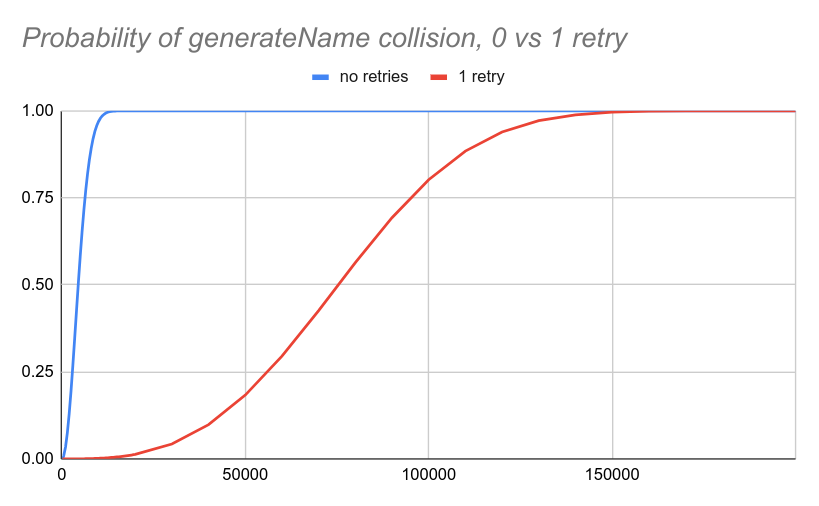
And the more retry attempts we allow, the lower the probability of collisions:
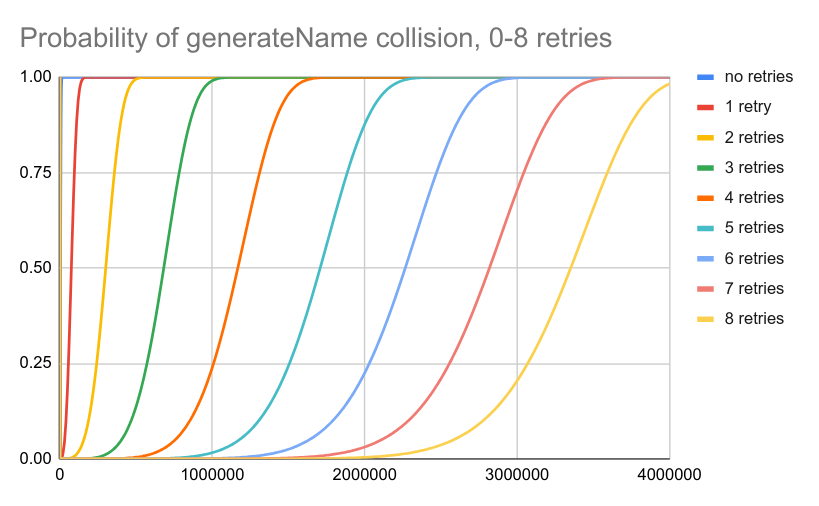
After 7 attempts, the probability of a conflict for 1 million entries drops below 0.1%.
For comparison, the probability of a conflict if we were instead to increase the number of chars are:
| random suffix chars | # of possible names | 50% probability of conflict when N names are added | 0.1% probability of conflict when N names are added |
|---|---|---|---|
| 5 | 14348907 | 5000 | 500 |
| 6 | 387420489 | 25000 | 900 |
| 7 | 10460353203 | 120000 | 5000 |
| 8 | 282429536481 | 650000 | 8000 |
| 9 | 7625597484987 | 3300000 | 120000 |
| 10 | 205891132094649 | 17000000 | 600000 |
| 11 | 5559060566555523 | 24000000 | 3400000 |
Here, we can see that we need 11 random suffix chars to for the “0.1% probability of conflict when N names are added” to exceed 1 million. The gives us a way to compare approaches; 7 retries provides roughly the same probability of conflict that we would get if we were to increased the number of random suffix chars to 11.
If we were to increase the number of random suffix chars we would break clients. We could argue that we had never guaranteed a random suffix char size and that we’re not technically breaking our API, but we know we would break some clients, including major downstream projects that use “{5}” regexes to match the random suffix. We consider breaking thes projects disruptive enough that we would not want to do it immediately without ample warning and a long wait period for fixes to propagate to the ecosystem.
This is why we favor this retry approach in the short term. It is an effective bandaid that makes the problem effectively go away for the vast majority of users and is something we can do now.
Note that if we were to add more random suffix chars, we would like increase it to more than 11 to reduce the potential for collisions to probabilities similar to git hash collision probabilities.
Test Plan
[x] I/we understand the owners of the involved components may require updates to existing tests to make this code solid enough prior to committing the changes necessary to implement this enhancement.
Prerequisite testing updates
Unit tests
- staging/src/k8s.io/apiserver/pkg/registry/generic/registry/store_test.go
- Mock out name generator to use monotonically-increasing integers
- Verify that a resource is generated with the max retries when conflicting names exist
- Verify that if max retries is exceeded that a already exists error is returned
- Verify that retries are not attempted when feature is disabled
Integration tests
- Verify that retries are not attempted when feature is disabled
- Verify that up to max retries are attempted when conflicting names exist
- Verify that if max retries is exceeded that a already exists error is returned
e2e tests
This feature is not e2e testable. There is no predictable way to trigger name collisions.
Graduation Criteria
Alpha
- Feature implemented behind a feature flag
- Unit tests added. The
generic/registry/store_test.gosuite covers this functionality remarkably well.
Beta
- Gather feedback from developers and surveys
- Add integration tests
- Additional tests are in Testgrid and linked in KEP
- Benchmark worst case: Max retries are attempted for all create requests.
- Consider further optimizing. One possible option: If the first create attempt conflicts, do a loop to check etcd for all subsequent name generations to make sure the name doesn’t exist before retrying the create request. This would be more efficient for cases where multiple retries are required while still keeping the non-conflicting case fast.
GA
- Add
retry_for_generate_name: truelabel toapiserver_request_duration_secondsmetric for requests that were retried.
This metric will be primarily used to determine if there is a problem with the
feature. In clusters optimized to store unusally high volumes of resources, this
might occur if a single generateName prefix is used for a large number of
resources (>1million).
Upgrade / Downgrade Strategy
N/A. This only reduces the probability of name conflicts when a request is served by an apiserver with this feature enabled.
Version Skew Strategy
N/A. This only reduces the probability of name conflicts when a request is served by an apiserver with this feature enabled.
Production Readiness Review Questionnaire
Feature Enablement and Rollback
How can this feature be enabled / disabled in a live cluster?
- Feature gate (also fill in values in
kep.yaml)- Feature gate name: RetryGenerateName
- Components depending on the feature gate: kube-apiserver
Does enabling the feature change any default behavior?
Yes, the default is to retry requests which will be visible to clients in latency, metrics and in validation admission webhook calls.
Can the feature be disabled once it has been enabled (i.e. can we roll back the enablement)?
Yes.
What happens if we reenable the feature if it was previously rolled back?
This is safe. The feature becomes enabled again.
Are there any tests for feature enablement/disablement?
Yes.
Rollout, Upgrade and Rollback Planning
How can a rollout or rollback fail? Can it impact already running workloads?
N/A
What specific metrics should inform a rollback?
apiserver_request_duration_seconds for create requests. If this metric
increases significantly when this feature is enabled, it may indicate
an issue with this feature.
We also plan to add a retry_for_generate_name: true label to this metric
to make it easy to inspect the latency of create requests where retries
occurred.
This metric will be primarily used to determine if there is a problem with the
feature. In clusters optimized to store unusally high volumes of resources, this
might occur if a single generateName prefix is used for a large number of
resources (>1million).
Were upgrade and rollback tested? Was the upgrade->downgrade->upgrade path tested?
N/A
Is the rollout accompanied by any deprecations and/or removals of features, APIs, fields of API types, flags, etc.?
No
Monitoring Requirements
How can an operator determine if the feature is in use by workloads?
Presence of the retry_for_generate_name: true label on the apiserver_request_duration_seconds metric
with a count greater than 1 would indicate this feature has been used.
How can someone using this feature know that it is working for their instance?
- Other
- Details: The lack of name conflict errors when using
generateNameis the only user visible behavior, but it is non-deterministic.
- Details: The lack of name conflict errors when using
What are the reasonable SLOs (Service Level Objectives) for the enhancement?
Create latency should remain unchanged because retries should be very rare under normal
operating conditions. I.e. apiserver_request_duration_seconds should not change.
What are the SLIs (Service Level Indicators) an operator can use to determine the health of the service?
- Metrics
- Metric name:
apiserver_request_duration_secondsfor creates- should be unchanged when
retry_for_generate_namelabel is unset - A change in latency when
retry_for_generate_name: truecan be used to monitor this features performance impact
- should be unchanged when
- Metric name:
Are there any missing metrics that would be useful to have to improve observability of this feature?
No
Dependencies
Does this feature depend on any specific services running in the cluster?
No
Scalability
Will enabling / using this feature result in any new API calls?
Yes, if the resource being created with generateName has validating webhooks registered, the validating webhooks will be called for each retry.
Will enabling / using this feature result in introducing new API types?
No
Will enabling / using this feature result in any new calls to the cloud provider?
No
Will enabling / using this feature result in increasing size or count of the existing API objects?
No
Will enabling / using this feature result in increasing time taken by any operations covered by existing SLIs/SLOs?
This can happen.
When a retry does occur, if the resource being created with generateName has
validating webhooks registered, the validating webhooks will be called for each
retry. For slow webhooks this could result in a significant increase to request
latency for the create requests using generateName.
We expect retries to be very rare, even for large numbers of resources
(100k-1M), but if a cluster were somehow able to generate a very large number of
resources for a generateName, say 2M or higher, then retries could become more
common.
Will enabling / using this feature result in non-negligible increase of resource usage (CPU, RAM, disk, IO, …) in any components?
No, at least not in all but the most pathological of situations.
If a cluster was receiving a high load of create requests for generateName
resources with a large number (millions) of existing resources already generated
with the same generateName prefix, this could cause up to a 7x increase in CPU.
But we do not expect this to actually happen, primarily because etcd cannot
support these volumes of resources.
Can enabling / using this feature result in resource exhaustion of some node resources (PIDs, sockets, inodes, etc.)?
No
Troubleshooting
How does this feature react if the API server and/or etcd is unavailable?
What are other known failure modes?
The only know failure modes are pathological. E.g. A runaway system creating unbounded resources using generateName could eventually trigger amplified load on webhooks with this feature.
What steps should be taken if SLOs are not being met to determine the problem?
Look at the number of resources (using kube-state-metrics or similar). If there
exists a very large number of resources (millions) of a particular resource kind
and they all share the same generateName prefix, this might be triggering
high retry load.
Implementation History
- 2024-01-31: KEP merged as implementable
- Kubernetes v1.30 - Implementation available as an off-by-default alpha feature
- Kubernetes v1.31 - Implementation available as an on-by-default beta feature
- Kubernetes v1.32 - Implementation available as a locked-to-enabled stable feature
Drawbacks
This code is in a critical system codepath, if anything is wrong with it, it could cause severe problems, up to and including data corruption and loss.
Alternatives
There are many alternatives that we considered including:
- Increasing the length of the random suffix appended to
generateNamewhen generating a name. This would be a breaking change in two ways:- There is a 63 char
namelength limit. To guarantee a 5 char random suffix length,generateNameis trimmed if its length is >58 chars. If the random suffix length were to be increased,generateNamewould either need to trim to a shorter length, breaking users that depend on 58 chars ofgenerateNamebeing preserved, or, we’d need to increates the length of the generatednamewould be a breaking for clients that have come to expect that the generated name size will never exceed 63 chars. - There are major downstream projects that use “{5}” regexes to match the random suffix.
- There is a 63 char
- After generating a name, check if the name exists in etcd and, if it does,
generate another name. See https://github.com/kubernetes/kubernetes/compare/master...jpbetz:kubernetes:retry-generate-name
The downside to this approach is that it adds a round-trip to etcd for
all create requests that use
generateName. - Add a “retry filter” to the apiserver’s filter chain to retry the entire request. This would reinvoke the entire admission chain and increase the latency of request handling more significantly than the other approaches considered.
- Introduce automatic retry logic into the client, either by default or an opt-in approach (special query param on create requests).
- Continue to require clients to explicitly check for the error and retry.