KEP-4153: Declarative Validation
KEP-4153: Declarative Validation of Kubernetes Native Types
- Release Signoff Checklist
- Summary
- Motivation
- Proposal
- Analysis of existing validation rules
- Design Details
- Production Readiness Review Questionnaire
- Implementation History
- Drawbacks
- Alternatives
- Infrastructure Needed (Optional)
Release Signoff Checklist
Items marked with (R) are required prior to targeting to a milestone / release.
- (R) Enhancement issue in release milestone, which links to KEP dir in kubernetes/enhancements (not the initial KEP PR)
- (R) KEP approvers have approved the KEP status as
implementable - (R) Design details are appropriately documented
- (R) Test plan is in place, giving consideration to SIG Architecture and SIG Testing input (including test refactors)
- e2e Tests for all Beta API Operations (endpoints)
- (R) Ensure GA e2e tests meet requirements for Conformance Tests
- (R) Minimum Two Week Window for GA e2e tests to prove flake free
- (R) Graduation criteria is in place
- (R) all GA Endpoints must be hit by Conformance Tests
- (R) Production readiness review completed
- (R) Production readiness review approved
- “Implementation History” section is up-to-date for milestone
- User-facing documentation has been created in kubernetes/website, for publication to kubernetes.io
- Supporting documentation—e.g., additional design documents, links to mailing list discussions/SIG meetings, relevant PRs/issues, release notes
Summary
With this enhancement, Kubernetes Developers will declare validation rules using
IDL tags in the types.go files that to define the Kubernetes native API types.
For example:
// staging/src/k8s.io/api/core/v1/types.go

// +validationRule="!self.hostNetwork || self.containers.all(c, c.containerPort.all(cp, cp.hostPort == cp.containerPort))"
type PodSpec struct {
  Containers []Container `json:...`
}

type Container struct {
  // ...

  Ports []ContainerPort `json:...`

  // ...
}

type ContainerPort struct {
  // ...

  // ...
  //
  // +minimum=1
  // +maximum=65535
  HostPort int32 `json:...`

  // ...
  //
  // +minimum=1
  // +maximum=65535
  ContainerPort int32 `json:...`

  // ...
}
In this example, both +validationRule, +minimum and +maximum are IDL tags.
The declarative validation rules will be used by the kube-apiserver to validate API requests.
The declarative validation rules will also be included in the published OpenAPI:
// Pod Spec
"openAPIV3Schema": {
  "type": "object",
  "x-kubernetes-validations": [
    {
      "rule": "!self.hostNetwork || self.containers.all(c, c.containerPort.all(cp, cp.hostPort == cp.containerPort))"
    }
  ],
}

...

// Container Port
"openAPIV3Schema": {
  "type": "object",
  "properties": {
    "hostPort": {
      "minimum": 1,
      "maximum": 65535
      ...
    }
    "containerPort": {
      "minimum": 1,
      "maximum": 65535
      ...
    }
  }
}
It is important to note that the declarative validation will use the same set of validation options available today for CRDs. namely:
- JSON Schema value validations (e.g.
format,maxItems) - CEL Validation Rules (e.g.
self.replicas <= self.maxReplicas) - Relevant merge strategy declarations (e.g.
listType=set)
Motivation
Kubernetes API validation rules are currently written by hand, which makes them difficult for users to access directly, review, maintain, and test.
Declarative validation will benefit Kubernetes maintainers:
- It will make it easier to develop, maintain and review APIs.
- It will make it easier programatically inspect and analyze the API, enabling new tools and improved documentation.
- It will enable improvements to the API machinery. For example, a feature like ratcheting validation will become more tractable to implement because the feature can be implemented once in the declarative validation subsystem rather than piecemeal across the 15k lines of hand written validation code.
Declarative validation will also benefit Kubernetes users:
- It will give users direct access to the most actual API validation rules, which are currently only available to developers willing and able to find and read the hand written validation rules.
- It will enable clients to perform validation of native types earlier in development worflows (“shift-left”), such as at with a Git pre-submit linter.
- It will improve API composition. In particular CRDs that embed native types (such as PodTemplate), which gain validation of the native type automatically. This has the potential to simplify controller development and improve end user experiences when using CRDs.
- Validation is performed on versioned type, so error message and attributed field path is more likely to be relevant to the user. (Though no known cases of misattributed field errors have yet occurred)
Please feel free to try out the prototype to get hands on experience with this proposed enhancement.
Goals
Vast majority (95%+) of hand written validation are replaced with declarative validation. The remaining hand written rules will primarily be rules that should not be published as part of the API, usually because server side state is involved in the validation decision.
types.gofiles become the de-facto IDL of Kubernetes for native types. It is worthing noting that+enumsupport,+defaultsupport and similar enhancements all moved our API development forward in this direction. This enhancement is an attempt to continue that story arc.API Validations and Defaults are readable and manageable. The IDL should be a joy to use for API authors, reviewers and maintainers. Common Complex relationships have simple-to-express idioms in the IDL.
CRDs and native types are validated and published in OpenAPI in a consistent and uniform way. Improvement we make to CEL to enable declarative validation of native types will be made available to CRD authors and vis-versa.
No change to error message structure for clients. Difference to clients is limited to minimal changes to error detail strings.
Non-Goals
- It is not a goal for all validation rules to be published to OpenAPI. There exist complex, stateful rules that should not be published in OpenAPI. These will remain “server side only” validation rules.
- It is not a goal to require that all validation rules be written in CEL. We will continue to support hand written validation rules indefinitely for use cases that are a poor fit using the existing validation mechanism (or something very similar).
Proposal
Declarative validation will be performed against versioned APIs. This differs from the hand written validation, which is evaluated against internal types.
Go IDL tags will be added to support the following declarative validation rules:
| Type of valiation | Go IDL tag | OpenAPI validation field | Reason Type |
|---|---|---|---|
| string format | +format={format name} | format | Invalid |
| size limits | +min{Length,Properties,Items}, +max{Length,Properties,Items} | min{Length,Properties,Items}, max{Length,Properties,Items} | TooMany, TooLong |
| numeric limits | +minimum, +maximum, +exclusiveMinimum, +exclusiveMaximum | minimum, maximum, exclusiveMinimum, exclusiveMaximum | Invalid |
| required fields | +optional (exists today) | required | Required |
| enum values | +enum (exists today) | enum | NotSupported |
| uniqueness | listType=set (sets and map keys) | x-kubernetes-list-type | Duplicate |
| regex matches | +pattern | pattern | Invalid |
| cross field validation | validationRule="{CEL expression}" | x-kubernetes-validations | user specified |
| transition rules | validationRule="{CEL expression using oldSelf}" | x-kubernetes-validations | user specified |
| special case: name format | +nameFormat={format name} | x-kubernetes-validations (see “format” section below for details) | Invalid |
Specific reason types can be customized for x-kubernetes-validations to
any supported field.Error reason.
xref: Kubernetes mapping of OpenAPI value validations to response code
During development we may add syntax sugar for common idioms we identify such as +immutable or +mutally_exclusive, +contextual (for unions) that desugar into equivalent CEL
Unions
Unions are informally defined but common in built-in types.
We will convert most union validation to CEL expressions. For example:
// staging/src/k8s.io/api/apps/v1/types.go

type DeploymentSpec struct {
  // ...
  //
  // +minimum=0
  Replicas string `json...`

  // ...
  //
  // +validationRule="!(self.type == 'Recreate') || !has(self.rollingUpdate)",message="may not be specified when strategy `type` is Recreate",reason=Forbidden,field="rollingUpdate"
  // +validationRule="!(self.type == 'RollingUpdate') || has(self.rollingUpdate)",message="this should be defaulted and never be nil",reason=Required,field="rollingUpdate"
  Strategy DeploymentStrategy `json:...`

  // ...
}
For backward compatibility with existing validations, reason and field will
be added to make it possible to declare a validation rule in CEL that matches
not just the logic of the hand written validation it replaces, but also the
exact field path and reason type.
There has been a past KEP to add support for Unions directly to OpenAPI, but it has since been dropped (xref)
CEL Validation
CEL will play a major role in declarative validation by offering a way to declare validation rules for use cases that are too complex to be declared using JSON Schema value validations. Using CEL to validate APIs has been successfully demonstrated by CRD Validation Rules, which are on track for GA in 1.28.
CEL rules will typically be placed on struct or field declarations and access multiple fields nested below the level of the type or field where the CEL expression is declared, e.g.:
  //+validationRule="!self.widgetType == 'Component' || !['badname2', 'badname2'].exists(notAllowed, self.componentName.contains(notAllowed))",reason=Forbidden
  type FizzBuzzSpec struct {
    Type WidgetType `json...`
    ComponentName string `json...`
  }
Note that the +validationRule IDL tags supports multiple optional fields after the expression string. The supported fields are:
message: A vailidation failure message string.messageExpression: A CEL expression that evalutes to a validation failure message string. Takes precedence over message.reason: Must be one of [Required, Forbidden, Invalid, RequestEntityTooLarge].field: A JSONPath to the sub-field that a validation failure should be attributed to.
We will need to extend our CEL libraries to make it possible to migrate all the validation rules that exist in the Kubernetes API today.
isFormat() <bool>andvalidateFormat() <list<string>>will be added to allow formats to be checked in CEL expression and for format violations to be reported usingmessageExpression: "self.validateFormat('ipv6')"- IP and CIDR library:
isIP(string) boolip(string) IPIP.is4() boolIP.is6() boolIP.isLoopback() boolisCIDR(string) boolcidr(string) CIDRCIDR.overlaps(CIDR) boolCIDR.containsIP(IP) bool
- UTF8 Library (for CRD validation, ManagedFields)
- IsValid
- IsPrint
- IsControl
- Selectors
Matches(LabelSelector)
Formats
A significant portion of all validation rules in the API check that a field
value conforms to a particular “format”. A prominent example is metadata.name
and metadata.generateName validation.
We will extend the available list of formats to cover formats heavily used by the Kubernetes API, namely:
| Format | Primary validate uses |
|---|---|
| ‘dns1123subdomain’ | metadata name and generateName |
| ‘dns1123label’ | metadata name and generateName |
| ‘dns1035label’ | Scoped names and keys |
We will add all of these to the supported list of formats in kube-openapi. We will also document all supported formats on the Kubernetes website.
Other candidate format types are:
APIVersion(GroupVersion)- Quantity
- Qualified name
- Fully qualified name
- Fully qualified domain name
- Label Value
- Integer (as opposed to any floating point)
Until CRD Validation Ratcheting is stable, these formats will be translated into an inline schema containing either the regex pattern or the CEL expression for the format. Related Note: k8s also supports unused formats that should be removed over time: https://github.com/kubernetes/kubernetes/issues/97733
IDL tags
IDL tags may be used directly on type declarations and indirectly on field and type aliases. For example:
type Widget struct {
  // +validationRule="self.matches('[a-z][1-9]+')"
  Component PartId `json...`
}

// +maxLength=20
type PartId = Identifier

// +format=dns1123label
type Identifier string

type Contraption struct {
  Component Identifier `json...`
}
In the above example, the widget.component field is validated against all three
IDL tags. But contraption.component is only validated against +format=dns1123label.
Shared types present a challenge. For example, different Kubernetes resources
have different validation rules for metadata.name and metadata.generateName.
But all resources share the ObjectMeta type.
We can support these uses cases with CEL validation rules:
type ExampleSpec struct {

  // +validationRule="!has(self.name) || self.name.isFormat('dns1123subdomain')",field="name"
  // +validationRule="!has(self.generateName) || self.generateName.replace('-$', 'a').isFormat('dns1123subdomain')",field="generateName"
  metav1.ObjectMeta `json...`
}
Because the above use case is so common, we plan to offer a special tag to make declaring the above rules convenient:
// +nameFormat='dns1123subdomain'
metav1.ObjectMeta `json...`
Another example: Pod container and initContainer fields share the same
Container type but have different validation rules. The rules that are the
same for both can be declared on Container but any rules that are different
can be declared on the container and initContainer fields using CEL. E.g.:
// +validationRule="!has(self.RestartPolicy)"
Containers []Container `json...`
Analysis of existing validation rules
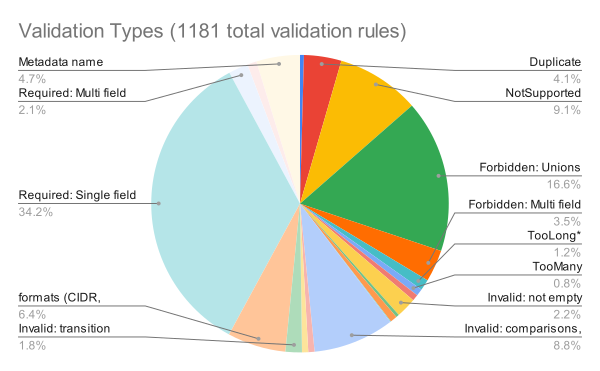
At the time of writing this document, there are 1181 validation rules written in about 15k lines of go code in kubernetes/kubernetes/pkg/apis.
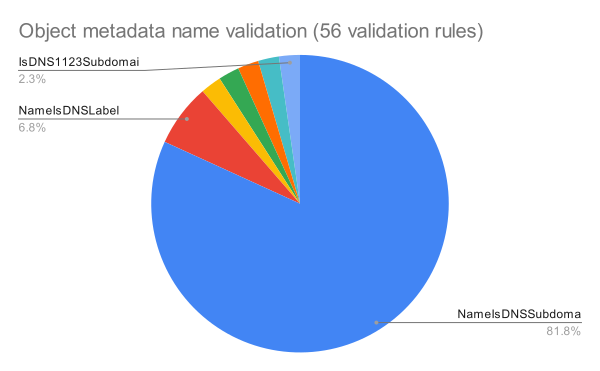
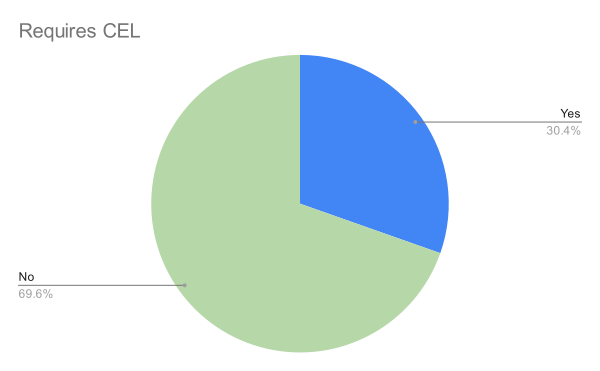
Roughly 30% of validation rules may require CEL expressions. 15% of these are forbidden rules which primarily check which fields are allowed when a union discriminator is set. 10% are object name validations, and the remaining 10% are cross field validation checks, mainly mutual exclusion and some “transition rules” (e.g. immutability checks).
The remaining 70% of validation rules can be represented using JSON Schema value
validations. optional, format and enum will the the most frequently used.
User Stories (Optional)
Kubernetes developer wishes to add a field to a existing API version
- Developer add the field to the Go struct
- Developer adds needed IDL tags to Go struct
- Developer adds validation_test.go cases (same as today)
- API reviewers review IDL tags along with Go struct change
Kubernetes devekoper adds a v1beta2 version of an API
- Develop copies over v1beta1 API and creates v1beta2
- Linter verifies that IDL tags match for both version of API (unless exceptions are put in exception file)
- API reviewer can review change knowing that validation is consistent unless there are lines added to exception file
User wishes to validate the YAML of a kubernetes native type as a Git pre-submit check
- OpenAPI of native types is downloaded from kube-apiserver
- Tool that checks YAML against OpenAPI schema is used to validate YAML in a Git pre-submit (there are tools being written now that will also handle x-kubernetes-validations)
User wishes to use Kubebuilder to define a custom resource that embeds PodTemplate
- Go struct that declares custom resource references the go struct of v1.PodTemplate.
- Kubebuilder recognizes the Go IDL tags introduced by this KEP (Note that Kubebuidler already has IDL tags: https://book.kubebuilder.io/reference/markers/crd-validation.html, but they are different than what we propose here)
- Kubebuilder generates appropriate OpenAPI for the CRD resulting in full validation of the PodTemplate
Notes/Constraints/Caveats (Optional)
Risks and Mitigations
Risk: Migration to Declarative Validation introduce breaking change to API validation
Mitigation: Ensure Invalid Objects Still Invalid
Objects which previously did not pass validation must still not pass validation. This can be restated simply as: all currently handwritten validations must be included in the schema. If all validations are in the schema, it follows that the schema will reject the same set of objects as before.
We can mitigate this by:
- All Validation Tests Have 100% Coverage
- All Validation Tests Succeed against native and schema-based validation backends
To accomplish this, we will:
- New Presubmit Verify Script to Ensure 100% for future tests
- A General Validation Test Framework - Most tests are already written declaratively, we will refactor them to all use a general framework for validation tests. The framework will evaluate the validation test case first on native types, then convert the case to each supported version of the kind to ensure the error arises also from schema-based validation. The framework will have a way to make exceptions for certain errors which are version-specific.
- Refactor all
validation_tests.gounit tests to have 100% coverage of their respectivevalidation.gofiles as well as make use of the validation test framework.
Mitigation: Ensure Valid Old Objects Still Valid
Objects which previously passed validation must still pass validation. For our purposes this can be thought of as ensuring the schema-based validation does not raise new errors which previously did not exist.
It is not possible to be 100% sure of this property, in fact, there may be new validations added to patch bugs in existing ones. But we can mitigate this risk:
- Catch and fix any significant differences in schema validations
During alpha and beta phases, we will run both validation systems in parallel and return the errors from the old system to the user. We will report in logs and metrics the differences. Over time we will reduce the number of reported differences to zero as these issues are caught.
To help catch these errors faster, we will also refactor all e2e tests to enable this feature and check for validation error differences.
- Minimize the impact of any new changes introduced
As a precondition of this KEP graduating to GA, the feature
CRD Validation Ratcheting must also reach GA. Validation Ratcheting would
reduce impact to users by allowing any new schema validations errors due to
this feature to be ignored for unchanged portions of an object.
Risk: Reduced the fidelity of validation error messages
OpenAPI value validations do not offer a way to specify an exact message or a reason type. It is also possible some of the more general api errors have error messages that contain context not found in OpenAPI Error.
Mitigation: Fallback to CEL
For cases where the potentially lost error message context must be retained, we can instead encode the rule as a CEL rule which allows for arbitrary error strings.
Mitigation: Explore x-kubernetes extension for custom error messages
An option to consider to all custom error messages to schema-based value
validations if we see that we really need it is to introduce a new extension:
x-kubernetes-validation-errors which maps schema validation fields to
a custom error message for failing that field’s validation:
minLength: 0
x-kubernetes-validation-errors:
  minLength:
    message: "this custom error message shows when violating minLength rather than default message"
    reason: Invalid
Risk: Added latency to API request handling.
The design decision to declaratively validate API versions has performance implications.
Today, the apiserver’s request handler decodes incoming versioned API requests to the versioned type and then immediately performs an “unsafe” conversion to the internal type when possible. All subsequent request processing uses the internal type as the “hub” type. Validation is written for the internal type and so are per-resource strategies.
With this change, the internal type will no longer be responsible for validation.
If we were to convert from the internal back to the version of the API request for validation, we would introduce one additional conversion. If we make this an “unsafe” conversion, than is will be low cost for the vast majority of requests.
We will benchmark this approach and plan to use it for alpha.
Long term, we could do better:
Since the internal type will no longer be used for validation, it becomes a lot less important. It is still important to have a hub type. But why not pick one of the versioned types to be the hub type? The vast majority of APIs only have one version anyway. The obvious candidate version to choose for the hub version would the perferred storage version.
Switching to a versioned type for the hub type would have a few implications:
- We would eliminate the need for internal versions.
- We would reduce the need for “unsafe” conversions (a small security win) since most APIs only have a single v1 version and so the entire request handling process would simply use that version.
- We would introduce more conversion when API request version differs from the hub version. But beta APIs are off-by-default and we expect a lot less mixed version API usage than in the past.
This “hub version” change feels like something that could be made somewhat independent of this KEP.
Mitigation: Avoid Conversion to Internal Type
Requests are received as the versioned type, so it should be feasible to avoid extra conversions for resources that have no need of handwritten validations.
Mitigation: Avoid Unstructured Conversion
SMD’s value wrappers have already been benchmarked and shown to have low overhead.
Mitigation: Use Value Validations Where Possible
Most validations will be possible to evaluate with simple value validations in native OpenAPI (required checks, enum value checks, etc). The rest are CEL expressions which are expected to account for 30% of all validation rule.
CEL evaluation is relatively efficient we will gather detailed benchmarks baselined against native types to demonstrate this.
Mitigation: Go fast paths for hot validation code paths
If CEL becomes a bottleneck, we may explore possibilities to run Go rather than interpreted CEL behind the scenes for certain hot code paths:
- Generate Go code from CEL expressions.
- Hand write validation code for select validations and call those directly (or from CEL).
Design Details
Improve Current Schema Quality
- Add declarative defaulting support to OpenAPI code generator
- OpenAPI Gen Enhancements
- Add IDL tags for all possible types of validations. Similar to kubebuilder crd markers
- Overridable defaults and validations of a reusable type
- Populate defaults for types defaulted to implicit zero
- Populate non-empty constraints for required fields
- Declarative Defaults to Constants
- IDL tags for common complex relationships we deem worthy (+immutable, +mutually_exclusive, +contextual)
- Introduce Feature Flag:
DeclarativeValidationExtensionsInOpenAPIto expose new extensions added to the schema.
x-kubernetes-validations. This field is published already for CRDs, so most clients should already be aware of handling it.- Must support multi-line expression entry, and multiple lines for reason,
code, fieldpath of a single rule. Retaining whitespace is NOT a requirement.
May use
"""or possibly explore Go-style multiline string literal.
- Must support multi-line expression entry, and multiple lines for reason,
code, fieldpath of a single rule. Retaining whitespace is NOT a requirement.
May use
x-kubernetes-errors: Mapping of OpenAPI V3 schema fields to custom error messagesx-kubernetes-strip-zero: Informs consumers of the schema that the object should be considered strip-zero if it takes on the given value
- Introduce new CEL libraries that will be needed to verify native schemas.
Publish Complex Validation Rules
Until now most validation rules have not been included in the schema, since they are not expressible using OpenAPI’s format.
Now that Kubernetes has GA support for CEL in CRDs, it makes sense to use the same feature to express rules for native types.
Publish Declarative Defaults in Schema
A consumer of a schema cannot fully take advantage of the schema for validation or linting purposes unless the can ably populate defaults. Many of our defaults are stored in constants.
We will add features to our code generation tools to refer to symbolic constants
from +default annotations, and populate OpenAPI with a higher proportion of our
defaults.
A list of existing differences between handwritten and schema-populated defaults can be found here.
Support Shared Template Schemas
Reusable template types pose a challenging problem since depending upon their usage they may have different defaults or validation constraints for multiple fields. This is not supported by our OpenAPI code generators.
One example is core.v1.PersistentVolume.Spec.Capacity. When used in a
regular PersistentVolume this field is required and cannot be empty.
However, when used inline as a template, Capacity is no longer required.
To address this we will need additional marker comments
We will need to add the ability for fields that re-use a type to specify a field-level for its nested fields. Kube-openapi gen will inline the custom definition.
Add missing required fields
Our kube-openapi code generator adds to the schema’s required fields
any field that is not labelled with +optional or omitempty JSON tag:
type Container struct {
	// Name of the container specified as a DNS_LABEL.
	// Each container in a pod must have a unique name (DNS_LABEL).
	// Cannot be updated.
	Name string `json:"name" protobuf:"bytes,1,opt,name=name"`
  ...
}
  "io.k8s.api.core.v1.Container": {
    "type": "object",
    "description": "A single application container that you want to run within a pod.",
    "required": [
      "name"
    ],
    "properties": {
      ....
      "name": {
        "default": "",
        "description": "Name of the container specified as a DNS_LABEL. Each container in a pod must have a unique name (DNS_LABEL). Cannot be updated.",
        "type": "string"
      },
      ....
    },
  }
But there are examples in our API where a required field is omitempty:
type Rule struct {
	// APIGroups is the API groups the resources belong to. '*' is all groups.
	// If '*' is present, the length of the slice must be one.
	// Required.
	// +listType=atomic
	APIGroups []string `json:"apiGroups,omitempty" protobuf:"bytes,1,rep,name=apiGroups"`

  ...
}
These fields are not included in the required list. To fix this, we can simply
add a +required field. All fields without +required or +optional explicitly
will use omitempty to infer default behavior as it does today.
Zero-Valued Primitive Fields
Serialization to Go can impact declarative validation, which interprets the
resource as an untyped JSON object, respecting go tags. Specifically zero is
often considered to be the same as unspecified.
Unless the fact that zero values are considered to be unset is captured in the schema:
- We won’t be able to accurately capture the Go validations into CEL or JSONSchema, or they will be buggy
- CRDs and native types with the same schema will not have the same validation behavior. Downstream clients of the schema such as kubectl-validate and ValidatingAdmissionPolicy will trip over this.
Required Zero Fields
For required fields that are not labelled as a pointer, we check them by
checking if their value is the empty value:
v1.Container.Name is such an example:
	namePath := path.Child("name")
	if len(ctr.Name) == 0 {
		allErrs = append(allErrs, field.Required(namePath, ""))
	} else {
		allErrs = append(allErrs, ValidateDNS1123Label(ctr.Name, namePath)...)
	}
apiregistration/v1.RuleWithOperations.APIGroups is such an example:
	if len(rule.APIGroups) == 0 {
		allErrors = append(allErrors, field.Required(fldPath.Child("apiGroups"), ""))
	}
This makes not only unspecified throw a required field error, but "" strings, []
slices, and {} maps. The schema for all required fields must be
updated to reflect that zero is considered unspecified.
| Type | Annotation |
|---|---|
| string | x-kubernetes-strip-zero: true |
| int | x-kubernetes-strip-zero: true |
| float | x-kubernetes-strip-zero: true |
| slice | x-kubernetes-strip-zero: true |
| map | x-kubernetes-strip-zero: true |
| pointer | N/A (codegen forces optional) |
| struct | N/A (codegen forces optional with default: {}) |
One alternative approach would be to set minimum, minLength, etc. on necessary
types. That approach has the drawback that the error messages will no longer say
the field was required but instead that the minimum was not met. Additionally,
x-kubernetes-strip-zero: true more directly expresses that empty is
considered unset, and is also needed to solve a similar problem for omitempty
fields.
Optional Zero Fields
Consider the following omitempty non-pointer field from DeploymentSpec:
type DeploymentSpec struct {
  ...

  Paused bool `json:"paused,omitempty"`

  ...
}
K8s 1.28 and below represents this field with the spec:
{
  ...
  "properties": {
    ...
    "paused": {
      "type": "boolean"
    }
    ...
  }
}
Paused implicitly defaults in Go to false.
This would surface as:
has(self.paused)in CEL on the Container object always returnsfalseif that value isfalse. But a CRD with identical schema would returntrue. A proof of concept example of how this bug could bite users of ValidatingAdmissionPolicy is here.- CEL and JSONSchema Validations of the field if they exist also will not run. This is a concern if empty values do not match the schema.
For optional fields this can be solved by annotating all non-pointer fields with
x-kubernetes-strip-zero: true.
Optional fields for which the implicit default is treated as a set value should
add a +default= annotation to their empty value. This will give better
ergonomics in CEL for fields like Paused
An exhaustive list of all 730 omit-empty non-pointer is found here. Struct types already have their defaults populated with the go zero value, so they are excluded from this list.
Code Generator Solution
A conservative change we can apply to the code generator would be to automatically
annotate x-kubernetes-strip-zero: true to all non-pointer fields.
Fields for which the implicit default is considered a set value can also add a
+default marker to express it explicitly over time, but it is not required to
correct the difference in native types vs CRDs. Defaulting should occur after
zero values are stripped, so fields with both should have zero and nulls defaulted
correctly.
Create a Library for Validation of Native Types
We will need a library that provides a function similar to Validate(schema, object, oldObject) error.
One might suggest to use the existing CRD validation logic for native types. There are quite a few reasons not to:
spec.Schemauses refs, and is possibly (self and/or mutually) recursive (e.g.: JSON, JSONSchemaProps). Not all native schemas are convertible to the structural schema type used by CRD validation code path.Native types are validated directly, and CRDs are validated as unstructured. We’d like to avoid losing too much performance to declarative validation. It would be very expensive to convert every object to unstructured for validation.
CEL validations in existing CRD validations do not work under quantifiers such as
allOf,anyOf,oneOf. This restriction is to avoid modifying the existing schema validation logic to support CEL validation. This can be worked around for now with CEL rules higher in the schema, but it would be a nice win for users if they could intermingle CEL with schema validations in the JSONSchema structure.The
kube-openapiopenapi validation code is full of questionable third party code which is not ideal to depend on for the future. It is difficult to extend such as for KEP-4008: CRD Validation Ratcheting. To change it to work for types other thanunstructuredwithout changing its behavior does not seem trivial.
To avoid duplicating code, we would like the validation system used for native types to be used also by CRDs. If not immediately, then it should be possible eventually.
To that end, given the constraints above, we will:
- Adapt existing CRD validation code to be performed against a common schema and value interface. We will re-use the one already employed by CEL for the same purpose of unifying native and CRD schema code.
- Create a version of the
kube-openapiswagger validator that operates onstructured-merge-diff’s benchmarkedvalue.Valueinterface used by Server-Side-Applyvalue.Valuecan be constructed from both native types andunstructured. In the best case we can re-use the same instance and perform validation with 0 conversions.
After doing so, we are able to use the same code to efficiently validate both CRDs and native types.
Enrichment of schemas
Before enriching schemas, we must create a framework for validation tests that runs both native and schema validators and compares the results.
Once we have a framework we will publish a tracking issue with an example of a group-version being annotated and instrumented with the framework. The issue will also include a guide for contributors to:
- Add declarative validation rules using Go IDL tags.
- Instrument validation_test.go unit tests to ensure declarative and handwritten validation produce the same errors, and have complete coverage of handwritten validation code.
- Instrument e2e testing to catch errors in declarative validation errors
- Report issues if they come up
Unit Test Instrumentation
To gain confidence that all existing validations are performed within the schema, we will add:
- A verify script that ensures
validation_test.gocode coverage ofvalidation.gofor all resources is equal to a value specified in a file committed to the repository so we may ratched coverage upwards over time. - A resource testing framework general enough to be used for all resource’s validation tests, as well as make possible exceptions for errors which only occur in specific versions of a type. The framework will validate the test case against all versions and both handwritten and schema backends.
Over time we will instrument all resources to use the framework and increase coverage to as close to 100% as possible for all resources.
E2E Test Instrumentation
To assist in finding discrepencies in errors faster, we will add method of running all e2e tests with Declarative Validation enabled to flag discrepencies in errors triggered by the e2e testing suite.
Error Message Equivalence
Some error messages will be phrased differently but preserve the same semantic meaning when converted to the declarative validation system. For our testing to check if errors are changed we have two options:
Write trusted regexes to match equivalence that work pretty well but have no guarantee of being complete.
We may choose to do this for cases where the probability of false equivalence is near-zero. e.g.
field.Required(fldPath, "")might have a slightly difference error from the standard openapirequired, but they should be seen as equivalent.For any other API field that might have a changed error message, we note the pairing in an exception file somewhere reachable from the comparison code.
Using Schemas for Validation
Once a critical mass of original resources have been annotated, and we have confidence in our tool, we will begin to use the schemas for validation:
- New Feature Flag
DeclarativeValidation
- Enables validation through schemas generated from the IDL tags
- Enables populating defaults from their values in the schemas
- Logs differences between native and schema-validation in an easily accessible way
- Only applies to resources (or groupversions, TBD) marked as supporting declarative validation
- Instrumentation of e2e tests - Instrument e2e tests with a method to run with declarative-validation enabled, and track all errors raised. This will help us ensure that support is complete before moving forward.
Request handling
Write requests are decoded, converted to internal, processed by any mutating admission plugins, processed before any create handlers, validated, then converted to the storage version and stored.
Our plan:
- Early Alphas: If feature flag is set, convert from internal back to versioned type (via unsafe where possible) for declarative validation. Because all CEL evaluation is currently written for unstructured values, we will convert to unstructured before declarative validation.
- Before graduation to Beta: Benchmark performance. Decide if we should invest in the “Switch hub version to be an API version” idea proposed in the performance risk section of this KEP. Also decide if we should invest in using using SMD value wrappers to avoid conversion to unstructured.
Validation of Unstructured input or Deserialized Go Type
Rather than validate directly on the unstructured JSON/YAML input, before validation we must deserialize the object into its Go type first.
We must validate after declarative and handwritten defaults, mutating admission, and other mutations are performed on a request object by the APIServer before the object is validated. It would be a large refactor to remove all Go type serialization from the APIServer request path. To do so is a non-goal of this KEP.
Declarative Validation will be performed upon an unstructured representation or view into the deserialized Go type, and not directly on user input.
Deprecation of Legacy Validation
- After DeclarativeValidation reaches GA and becomes default
- Deprecation of Legacy Validation is Announced
- …Deprecation wait period passes…
- Legacy validation code that is being validated declaratively can safely be deleted
Prototype Notes
The core changes proposed here can be implemented with only a small set of code changes. A working prototype was built quite quickly by leveraging code that was merged recently as part of other CEL work. The main changes were:
- Extend kube-openapi to add the needed Go tag support (Draft PR: https://github.com/kubernetes/kube-openapi/pull/381)
- Reuse the same validator as used today for CRDs, but generalize it to work with native types
- This was be done by leveraging https://github.com/kubernetes/kubernetes/pull/113312 and https://github.com/kubernetes/kubernetes/pull/116267 to handle the resolution and conversion of native type schemas
Test Plan
[x] I/we understand the owners of the involved components may require updates to existing tests to make this code solid enough prior to committing the changes necessary to implement this enhancement.
Prerequisite testing updates
None
Unit tests
See Unit Test Instrumentation for unit testing plan.
k8s.io/apiserver/pkg/cel/openapi:10/02/2023-84.8k8s.io/apiserver/pkg/cel/library:10/02/2023-69k8s.io/apiextensions-apiserver/pkg/apiserver/schema/cel/model:10/02/2023-83.3
Integration tests
We will have tests to ensure that a validator can be successfully created for each resource type’s schema, and a valid object can be successfully validated for each resource type against its schema.
e2e tests
We will instrument as many e2e tests as possible to be able to use the feature gating, cross checking and logging of declarative validation and legacy validation. Any differences should result in a test failure. We may be able to produce a report via k8s CI after running all e2e tests with the feature enabled showing validation differences.
Graduation Criteria
Alpha
DeclarativeValidationExtensionsInOpenAPI
- Code generator supports OpenAPI IDL tags
x-kubernetes-validationspopulated by openapi-gen from IDL tag- x-kubernetes-validations stripped if flag not enabled
- Unit tests
- Enablement/Disablement tests
DeclarativeValidation
- Validation of Native Objects is performed for enabled resources and differences are logged
- Validation Library based on
common.Schema - Validation Library Unit tests
- Enablement/Disablement tests
- Initial e2e tests completed and enabled
Beta
DeclarativeValidationExtensionsInOpenAPI
x-kubernetes-strip-zeroandx-kubernetes-errorssupport added, or solution to problems they intend to solve found.
DeclarativeValidation
- Have annotated and enabled declarative validation for all native groupversions
- Have instrumented annotated resources validation unit tests to run against versioned schema.
GA
- Have instrumented all annotated resources validation unit tests to run against versioned schema.
- All Unit and Integration tests pass with no errors or only well-understood exceptional errors sourced from a file in the repository
Upgrade / Downgrade Strategy
For the introduction of new formats in CRDs:
Today, supported formats is used strip out unsupported
formats when used in older version of the kube-apiserver. We will extend this to have
two lists: supported and storage. All new formats will be added to storage for
at least one minor release of Kubernetes before the format is added to supported so
that any usages of the new formats written to CRDs downgrade safely.
Version Skew Strategy
This change does not affect any communications going out of the apiserver. This change may affect the validation codepath used for mutating client requests.
Due to this change we may choose to support additional format strings in schemas.
To mitigate risk from this and possible other new validations added we
will implement validation ratcheting on the validation of the native types,
similar as is done for CRDS in KEP-4008. This would
ensure old values that fail new validation strategies will remain validating.
New values written passing the new validation system should be expected also to pass the old validation: we do not expect to loosen any validation rules, though a few may be tightened.
Production Readiness Review Questionnaire
Feature Enablement and Rollback
How can this feature be enabled / disabled in a live cluster?
- Feature gate (also fill in values in
kep.yaml)- Feature gate name: DeclarativeValidation, DeclarativeValidationExtensionsInOpenAPI
- Components depending on the feature gate: kube-apiserver
- Other
- Describe the mechanism:
- Will enabling / disabling the feature require downtime of the control plane?
- Will enabling / disabling the feature require downtime or reprovisioning
of a node? (Do not assume
Dynamic Kubelet Configfeature is enabled).
Does enabling the feature change any default behavior?
DeclarativeValidationExtensionsInOpenAPIExposes new
x-kubernetesextensions proposed by this KEP in the OpenAPI schema for native types.DeclarativeValidation- Alpha: Runs both declarative and native validation. Returns native validations to user. Report differences in validations in logs and metrics
- Alpha: Runs both declarative and native validation. Returns native validations to user. Report differences in validations in logs and metrics
- GA: Uses schema based validation for user errors. Legacy validations removed over time.
Can the feature be disabled once it has been enabled (i.e. can we roll back the enablement)?
- DeclarativeValidationExtensionsInOpenAPI: Yes, this feature only changes published OpenAPI schema and does not affect rollbacks.
- DeclarativeValidation:
- Alpha: Native Validations are still used to decide whether objects are persisted to storage
- Beta & GA: Since validation is used to persist objects to storage, if there was a mistake and it permits objects that should not be persisted, rollback may be impacted by preventing updates on that object until the error is fixed.
What happens if we reenable the feature if it was previously rolled back?
- DeclarativeValidationExtensionsInOpenAPI: Yes, this feature only changes published OpenAPI schema and does not affect rollbacks.
- DeclarativeValidation: If the port to declarative validation is not accurate, during an update, old parts of an object may be seen as invalid and need to be ratcheted.
Are there any tests for feature enablement/disablement?
Before targeting to beta, this enhancement will have tests for:
- Ensuring x-kubernetes-validations is present if the feature is enabled
- Ensuring x-kubernetes-validations is not present if the feature is disabled
- Ensuring schema validation errors are used/logged if the feature is enabled
- Ensuring schema validation errors are not used/logged if the feature is disabled
Rollout, Upgrade and Rollback Planning
This section must be completed when targeting beta to a release.
How can a rollout or rollback fail? Can it impact already running workloads?
Beta & GA:
A rollout can fail by being too strict with updates. If the ported declarative validations are stricter than native validations then workloads may not be able to execute their update operations.
A rollback can fail if our declarative validations are too loose. Workloads wont be able to update objects with an invalid field until the object is corrected.
What specific metrics should inform a rollback?
Were upgrade and rollback tested? Was the upgrade->downgrade->upgrade path tested?
Is the rollout accompanied by any deprecations and/or removals of features, APIs, fields of API types, flags, etc.?
No.
Monitoring Requirements
This section must be completed when targeting beta to a release.
For GA, this section is required: approvers should be able to confirm the previous answers based on experience in the field.
How can an operator determine if the feature is in use by workloads?
apiserver_declarative_validation_difference_total > 0
How can someone using this feature know that it is working for their instance?
- Events
- Event Reason:
- API .status
- Condition name:
- Other field:
- Other (treat as last resort)
- Details:
What are the reasonable SLOs (Service Level Objectives) for the enhancement?
What are the SLIs (Service Level Indicators) an operator can use to determine the health of the service?
- Metrics
- Metric name: apiserver_declarative_validation_difference_total (counter)
- (only in Alpha and Beta releases, GA will not execute both validation backends)
- Metric name: apiserver_declarative_validation_difference_seconds (histogram)
- (only in Alpha and Beta releases, GA will not execute both validation backends)
- Metric name: apiserver_declarative_validation_seconds (histogram)
- Components exposing the metric: kube-apiserver
- Metric name: apiserver_declarative_validation_difference_total (counter)
Are there any missing metrics that would be useful to have to improve observability of this feature?
Dependencies
This section must be completed when targeting beta to a release.
Does this feature depend on any specific services running in the cluster?
Scalability
For alpha, this section is encouraged: reviewers should consider these questions and attempt to answer them.
For beta, this section is required: reviewers must answer these questions.
For GA, this section is required: approvers should be able to confirm the previous answers based on experience in the field.
Will enabling / using this feature result in any new API calls?
No
Will enabling / using this feature result in introducing new API types?
No
Will enabling / using this feature result in any new calls to the cloud provider?
No
Will enabling / using this feature result in increasing size or count of the existing API objects?
No
Will enabling / using this feature result in increasing time taken by any operations covered by existing SLIs/SLOs?
DeclarativeValidationsInOpenAPI: No.
DeclarativeValidation: Yes, when enabled feature may impact validation time. Benchmarks will be taken to measure impact.
Will enabling / using this feature result in non-negligible increase of resource usage (CPU, RAM, disk, IO, …) in any components?
DeclarativeValidationsInOpenAPI: No.
DeclarativeValidation: Yes, when enabled feature may impact validation CPU and RAM usage. Benchmarks will be taken to measure impact.
Can enabling / using this feature result in resource exhaustion of some node resources (PIDs, sockets, inodes, etc.)?
No
Troubleshooting
This section must be completed when targeting beta to a release.
For GA, this section is required: approvers should be able to confirm the previous answers based on experience in the field.
How does this feature react if the API server and/or etcd is unavailable?
No change in behavior.
What are other known failure modes?
- Fail to create validator due to invalid generated schema on native type:
- Detection: API server crashes on startup due to error creating validator
- Mitigations: Update Kubernetes (in unlikely event we ever ship a release where this occurs)
- Diagnostics: Errors in log about failure to create validator and why
- Testing: We have an integration test in the testing plan to ensure that all builtin resources can successfully create a validator and validate a stub object