KEP-3902: Decouple TaintManager from NodeLifeCycleController
KEP-3902: Decouple Taint-based Pod Eviction from Node Lifecycle Controller
- Release Signoff Checklist
- Summary
- Motivation
- Proposal
- Design Details
- Production Readiness Review Questionnaire
- Implementation History
- Drawbacks
- Alternatives
- Infrastructure Needed (Optional)
- Note
Release Signoff Checklist
Items marked with (R) are required prior to targeting to a milestone / release.
- (R) Enhancement issue in release milestone, which links to KEP dir in kubernetes/enhancements (not the initial KEP PR)
- (R) KEP approvers have approved the KEP status as
implementable - (R) Design details are appropriately documented
- (R) Test plan is in place, giving consideration to SIG Architecture and SIG Testing input (including test refactors)
- e2e Tests for all Beta API Operations (endpoints)
- (R) Ensure GA e2e tests meet requirements for Conformance Tests
- (R) Minimum Two Week Window for GA e2e tests to prove flake free
- (R) Graduation criteria is in place
- (R) all GA Endpoints must be hit by Conformance Tests
- (R) Production readiness review completed
- (R) Production readiness review approved
- “Implementation History” section is up-to-date for milestone
- User-facing documentation has been created in kubernetes/website, for publication to kubernetes.io
- Supporting documentation—e.g., additional design documents, links to mailing list discussions/SIG meetings, relevant PRs/issues, release notes
Summary
In Kubernetes, NodeLifecycleController applies predefined NoExecute taints (e.g., Unreachable, NotReady) when the nodes are determined to be unhealthy. After the nodes get tainted, TaintManager does its due diligence to start deleting running pods on those nodes based on NoExecute taints, which can be added by anyone.
In this KEP, we propose to decouple TaintManager that performs taint-based pod eviction from NodeLifecycleController and make them two separate controllers: NodeLifecycleController to add taints to unhealthy nodes and TaintEvictionController to perform pod deletion on nodes tainted with NoExecute effect.
This separation not only improves code organization but also makes it easier to improve TaintEvictionController or build custom implementations of the taint based eviction.
Motivation
NodeLifecycleController combines two independent functions:
- Adding a pre-defined set of
NoExecutetaints to nodes based on the node conditions - Performing pod eviction on
NoExecutetaints
Splitting the NodeLifecycleController based on the above functionalities will help to disentangle code and make future extensions to either component manageable.
Goals
- Move taint-based eviction implementation out of
NodeLifecycleControllerinto a separate and independent taint-manager to enhance separation of concerns, maintainability.
Non-Goals
The main focus of the KEP is on the separation of concerns between NodeLifecycleController and TaintEvictionController, which will improve code organization and enable future extensions to TaintEvictionController. While it is true that the separation allows cluster operators to build custom TaintEvictionController and disable the default TaintEvictionController, this is a side-effect of the change rather than the main goal. the KEP emphasizes the benefits of the separation of concerns and briefly mention the option to disable the default TaintEvictionController as a potential side-effect.
The non-goals are the following.
- Introduce extra maintenance burden or regression after the code reorganization
- Introduce incompatible behavior of
NodeLifecycleControllerorTaintEvictionController - Extend and enhance the current built-in APIs for customization of node taint-based eviction, including additional fields, more flexible communication protocols, webhooks and CRD references, etc.
- Actual extension and enhancement of the current
TaintEvictionController.
Proposal
User Stories (Optional)
While this split is for improving the code maintainability, an effect of this change is that it allows cluster-admins to extend and enhance the default TaintEvictionController and even replace the default TaintEvictionController with a custom implementation. However, discussing such use-cases for extending TaintEvictionController or writing custom TaintEvictionController is beyond the scope of this KEP.
Story
Notes/Constraints/Caveats (Optional)
Risks and Mitigations
Compared with a single combined controller, the risks of using two separate controllers include the following.
- Slightly increase the communication overhead from applying node taints to performing pod eviction.
- Make cancellation of pod eviction and un-tainting nodes harder.
However, the performance overhead of the split controllers is expected to be small, and pod eviction cancellation and un-tainting nodes are not common use cases. Splitting NodeLifecycleController is more beneficial by promoting a cleaner design and enhancing the overall maintainability and extensibility in the long term.
Design Details
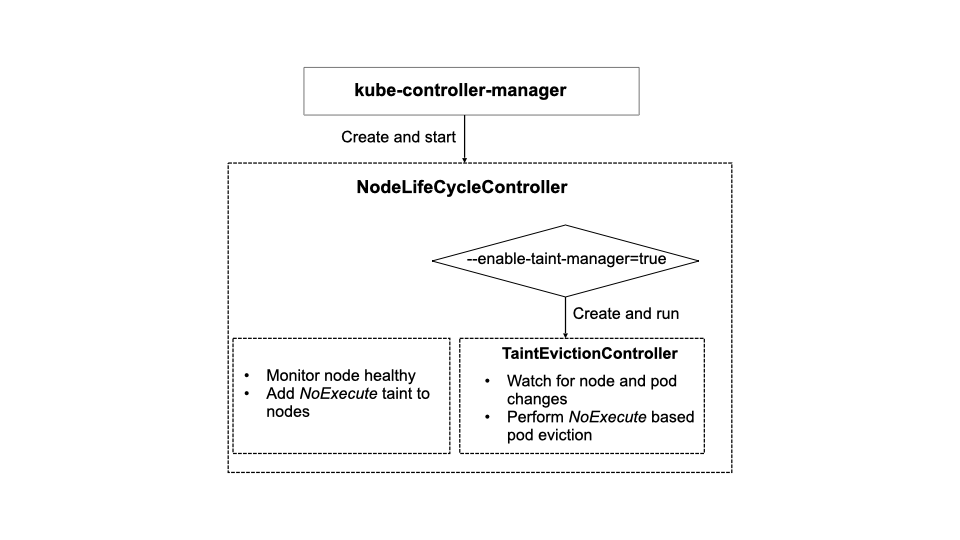
In Kubernetes version 1.27 and earlier, the NoExecuteTaintManager component is included within the NodeLifecycleController.
Proposed Controllers
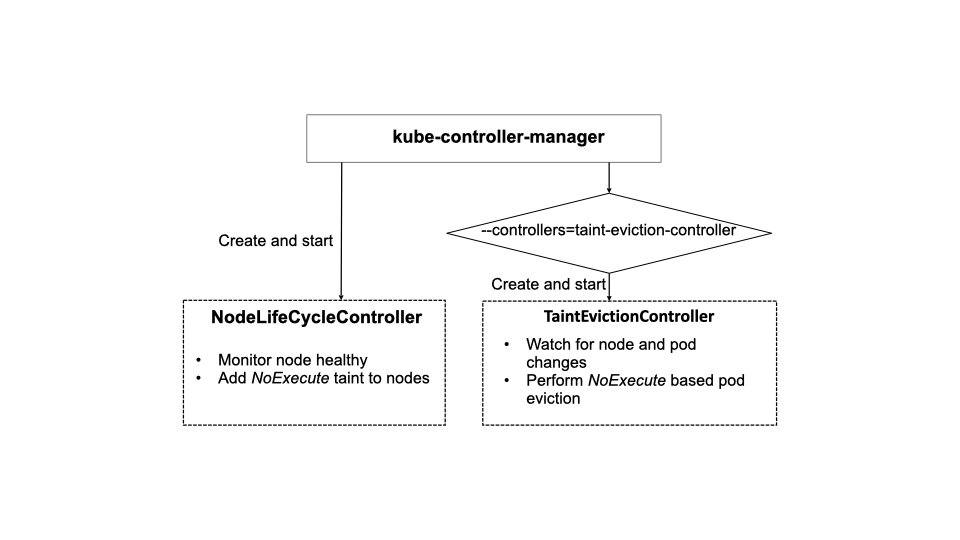
The proposed design refactors NodeLifecycleController into two independent controllers, which are managed by kube-controller-manager.
NodeLifecycleControllermonitors node health and addsNotReadyandUnreachabletaints to nodesTaintEvictionControllerwatches for node and pod updates, and performsNoExecutetaint based pod eviction
The existing kube-controller-manager flag --controllers can be used to optionally disable the TaintEvictionController.
Implementation
A new NodeLifecycleManager is implemented by removing taint-manager related code from controller/nodelifecycle/node_lifecycle_controller.go.
A new TaintEvictionController is created as a top-level controller managed by kube-controller-manager. Its implementation is based on the current taint-manager from controller/nodelifecycle/taint-manager.go.
The creation and startup of the default taint-manager is performed by kube-controller-manager. A feature gate SeparateTaintEvictionController controls whether to use the split TaintEvictionController or roll back to the old NodeLifecycleController.
Test Plan
[x] I/we understand the owners of the involved components may require updates to existing tests to make this code solid enough prior to committing the changes necessary to implement this enhancement.
Prerequisite testing updates
Kubernetes already has a good coverage of node No-Execute eviction. We will add tests only for the changed code.
Unit tests
pkg/controller/tainteviction: 2024-09-18 - 81.8%- Enable and disable the new
TaintEvictionController - The new
TaintEvictionControlleracts on node taints properly
- Enable and disable the new
pkg/controller/nodelifecycle: 2024-09-18 - 68% (target 80% before GA)- Test the combined controller
pkg/controller/nodelifecycle/scheduler: 2024-09-18 - 85.3%- Test the combined controller
Integration tests
Verify the ability to enable and disable the default
TaintEvictionController.Verify the new
TaintEvictionControllerto act on node taints properly.test/integration/node/lifecycle_test.go#TestEvictionForNoExecuteTaintAddedByUser: k8s-triagetest/integration/node/lifecycle_test.go#TestTaintBasedEvictions: k8s-triage
E2E tests
Verify the new controllers to pass the existing E2E and conformance tests using the split
TaintEvictionController.Manually test rollback and the
upgrade->downgrade->upgradepath to verify it can pass the existing e2e tests.test/e2e/node/taints.go: k8s-triage
Graduation Criteria
Alpha
Since there are no new API changes, we can skip Alpha and go to Beta directly.
Beta
- Support
kube-controller-managerflag--controllers=-taint-eviction-controllerto disable the defaultTaintEvictionController. - Unit and e2e tests completed and passed.
- Update documents to reflect the changes.
- In the past, the taint-manager was running as an internal controller in the
NodeLifecycleManager, so moving and renaming it as a new top-level controller has a low chance of degrading performance. And no bugs are reported in the current implementation.
GA
- No negative feedback.
Upgrade / Downgrade Strategy
A feature gate SeparateTaintEvictionController enables and disables the new feature. When the feature is turned on, a user can use kube-controller-manager’s flag to disable the default TaintEvictionController.
Regarding taint-based eviction, all versions of kube-controller-manager have this feature. The key difference is which controller implements the feature. The feature is implemented in the NodeLifecycleController before v1.29; the feature is implemented in a separate controller since v1.29.
For upgrade/downgrade scenarios, only one instance of the controller is leader and does the taint-based eviction.
- If the newer instance becomes a leader, the taint-based eviction will work as usual.
- If the older instance becomes a leader, the taint-based eviction will work as usual.
But if the cluster admin disables the default controller via the kube-controller-manager’s flag during upgrading, the taint-based eviction won’t work once the newer instance becomes a leader.
Version Skew Strategy
This feature affects only the kube-controller-manager, so there is no issue with version skew with other components.
Production Readiness Review Questionnaire
Feature Enablement and Rollback
How can this feature be enabled / disabled in a live cluster?
- Feature gate (also fill in values in
kep.yaml)- Feature gate name: SeparateTaintEvictionController
- Components depending on the feature gate: kube-controller-manager
Does enabling the feature change any default behavior?
No, the default NodeLifecycleManager and TaintEvictionController behavior will stay the same.
Can the feature be disabled once it has been enabled (i.e. can we roll back the enablement)?
Yes. Once rolled back, TaintEvictionController is enabled along with NodeLifecycleController.
What happens if we reenable the feature if it was previously rolled back?
The feature will work as usual.
Are there any tests for feature enablement/disablement?
No enablement/disablement tests are needed since this is in-memory feature and just regular tests with the feature being enabled/disabled do the job.
Rollout, Upgrade and Rollback Planning
How can a rollout or rollback fail? Can it impact already running workloads?
This is an opt-in feature, and it does not change any default behavior. Unless there is a bug in the implementation, a rollout can not fail. If a rollout does fail, running workloads will not be evicted properly on tainted nodes. We don’t except a rollback can fail.
What specific metrics should inform a rollback?
A significantly changing number of pod evictions (taint_eviction_controller_pod_deletions_total) and/or a substantial increase in pod eviction latency (taint_eviction_controller_pod_deletion_duration_seconds) in Kubernetes.
Were upgrade and rollback tested? Was the upgrade->downgrade->upgrade path tested?
Manually tested. No issues were found when we enabled the feature gate -> disabled it -> re-enabled the feature gate.
Upgrade->downgrade->upgrade testing was done manually using the following steps:
- Create a cluster in v1.29, the
SeparateTaintEvictionControllerenabled by default. - Run the existing e2e tests to verify the new controllers work as expected. Above mentioned metrics found.
- Simulate downgrade by modifying control-plane manifests to disable
SeparateTaintEvictionController. - Run the existing e2e tests to verify the current behavior without the new controllers.
- Simulate upgrade by modifying control-plane manifests to enable
SeparateTaintEvictionController. - Repeat step 2.
The e2e tests are mentioned in the Test Plan section.
Is the rollout accompanied by any deprecations and/or removals of features, APIs, fields of API types, flags, etc.?
No
Monitoring Requirements
How can an operator determine if the feature is in use by workloads?
It can be determined by if the feature gate SeparateTaintEvictionController is used or not.
How can someone using this feature know that it is working for their instance?
- Other (treat as last resort)
- Details: Node taints and taint-based pod eviction should work as usual and there is no significant change in the number pod evictions and pod eviction latency.
What are the reasonable SLOs (Service Level Objectives) for the enhancement?
The performance of node taint-based eviction should remain the same level as before.
What are the SLIs (Service Level Indicators) an operator can use to determine the health of the service?
The metrics for both NodeLifecycleController and TaintEvictionController’s queues should stay the same levels as before, the number of pod evictions and pod eviction latency.
- Metrics
- Metric name:
taint_eviction_controller_pod_deletions_total,taint_eviction_controller_pod_deletion_duration_seconds - Components exposing the metric:
kube-controller-manager
- Metric name:
Are there any missing metrics that would be useful to have to improve observability of this feature?
No
Dependencies
Does this feature depend on any specific services running in the cluster?
No
Scalability
Will enabling / using this feature result in any new API calls?
No
Will enabling / using this feature result in introducing new API types?
No
Will enabling / using this feature result in any new calls to the cloud provider?
No
Will enabling / using this feature result in increasing size or count of the existing API objects?
No
Will enabling / using this feature result in increasing time taken by any operations covered by existing SLIs/SLOs?
It may slightly increase the time of pod eviction.
Will enabling / using this feature result in non-negligible increase of resource usage (CPU, RAM, disk, IO, …) in any components?
No
Can enabling / using this feature result in resource exhaustion of some node resources (PIDs, sockets, inodes, etc.)?
No
Troubleshooting
How does this feature react if the API server and/or etcd is unavailable?
The same behavior as the current version: fail to add taint and/or evict pods on tainted nodes.
What are other known failure modes?
No
What steps should be taken if SLOs are not being met to determine the problem?
If the pod eviction latency increases significantly, validate if the communication between NodeLifecycleController and TaintEvictionController works. If the number of pod evictions is abnormal, run tests to verify the TaintEvictionController works properly.
Implementation History
- 2023-03-06: Initial KEP published.
- 2023-10-23: KEP updated to update name of the
SeparateTaintEvictionControllerfeature-flag and exposed metrics. - 2025-04-24: KEP promoted to Stable.
Drawbacks
Alternatives
Keeping the code as-is is an option, but it will make future extension of TaintEvictionController harder and less flexible.
Infrastructure Needed (Optional)
N/A
Note
taint-manager, TaintManager and TaintEvictionController are used interchangeably in this doc.