KEP-1558: Cleaning up container streaming requests
Cleaning up container streaming requests
Table of Contents
Release Signoff Checklist
ACTION REQUIRED: In order to merge code into a release, there must be an issue in kubernetes/enhancements referencing this KEP and targeting a release milestone before Enhancement Freeze of the targeted release.
For enhancements that make changes to code or processes/procedures in core Kubernetes i.e., kubernetes/kubernetes, we require the following Release Signoff checklist to be completed.
Check these off as they are completed for the Release Team to track. These checklist items must be updated for the enhancement to be released.
- kubernetes/enhancements issue in release milestone, which links to KEP (this should be a link to the KEP location in kubernetes/enhancements, not the initial KEP PR)
- KEP approvers have set the KEP status to
implementable - Design details are appropriately documented
- Test plan is in place, giving consideration to SIG Architecture and SIG Testing input
- Graduation criteria is in place
- “Implementation History” section is up-to-date for milestone
- User-facing documentation has been created in kubernetes/website, for publication to kubernetes.io
- Supporting documentation e.g., additional design documents, links to mailing list discussions/SIG meetings, relevant PRs/issues, release notes
Note: Any PRs to move a KEP to implementable or significant changes once it is marked implementable should be approved by each of the KEP approvers. If any of those approvers is no longer appropriate than changes to that list should be approved by the remaining approvers and/or the owning SIG (or SIG-arch for cross cutting KEPs).
Note: This checklist is iterative and should be reviewed and updated every time this enhancement is being considered for a milestone.
Summary
There are several features and flags for handling container streaming requests (exec/attach/port-forward). Having so many different ways of handling these requests unnecessarily complicates configuration, and opens the cluster to potential security risks. This is a proposal to consolidate the current options into a single supported configuration. Specifically, it proposes:
- Deprecate the Kubelet’s
--redirect-container-streamingfeature - Deprecate the
StreamingProxyRedirectsfeature
Background
The Kubelet’s --redirect-container-streaming option controls whether the Kubelet proxies the
streaming request to the CRI streaming server locally (when --redirect-container-streaming=false)
or if the Kubelet forwards the CRI streaming server address to the apiserver (when
--redirect-container-streaming=true). This option was added in v1.11, and defaults to false
(proxy locally).
The apiserver is expecting to upgrade the connection to the Kubelet to proxy back to the
client. However, in order to handle a redirect from the Kubelet, the apiserver will peak at the
first 16384 bytes from the Kubelet to check for and follow a redirect. This behavior is controlled
by the StreamingProxyRedirects feature gate, which is beta and default-enabled as of v1.6. To
mitigate SSRF attacks from a compromised Kubelet, the ValidateProxyRedirects feature was added in
v1.10 (beta in v1.14). ValidateProxyRedirects ensures that the redirect location is on the same host
as the original exec request to the Kubelet.
To summarize, here is a table describing the interaction of redirect-container-streaming and
StreamingProxyRedirects:
StreamingProxyRedirects=true | StreamingProxyRedirects=false | |
|---|---|---|
--redirect-container-streaming=false | Default configuration Kubelet proxies locally (see Proposal diagram) | Kubelet proxies locally |
--redirect-container-streaming=true | Kubelet responds with a 302 redirect, apiserver follows the redirect. | Kubelet responds with a 302 redirect, apiserver proxies redirect to the client, request fails. |
Motivation
The StreamingProxyRedirects feature was originally added as part of the migration the Container
Runtime Interface. One of the initial goals was to bypass the Kubelet for these long-running
requests in order to better account the request overhead. However, the apiserver is still
responsible for proxying these requests, so the gains of bypassing the Kubelet are
marginal. Furthermore, the redirect handling significantly complicates the apiserver stream
handling, and opens it up to potential SSRF attacks, so we added the ValidateProxyRedirects
feature to mitigate those.
When we went to add mTLS support to the runtime streaming server, we realized getting the right
certs established between the apiserver and the runtime was complicated, but the apiserver already
had an mTLS connection to the Kubelet. So, we added the ability for the Kubelet to connect the
stream locally and proxy the connection back to the apiserver. This setup is more secure, removes
the need for StreamingProxyRedirects and ValidateProxyRedirects, but adds the Kubelet back into
the long-running request chain. For background, see the discussion on kubernetes/kubernetes#36666
(comment).
StreamingProxyRedirects and ValidateProxyRedirects are currently in Beta, and should either be
graduated or removed.
Goals
- Simplify secure container runtime setup and operation
- Remove conformance dependencies on beta features
Non-Goals
Design a high-bandwidth low-latency production ready streaming channel to containers. Such a system should go through an ingress point other than the apiserver, and could be implemented (or at least prototyped) out of tree by leveraging the new ephemeral containers feature.
Proposal
After the transition period, the only way to configure container streaming will be
using the local redirect with Kubelet proxy approach. Under this configuration, handling streaming
redirects are not needed by the apiserver, so StreamingProxyRedirects will be deprecated and
eventually removed. Once StreamingProxyRedirects are removed, ValidateProxyRedirects is no
longer needed and can be removed. Finally, the --redirect-container-streaming flag will be
deprecated and eventually removed.
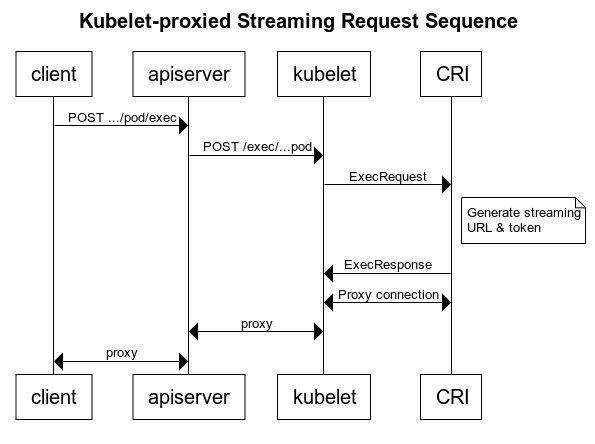
Upon completion, streaming requests will be forwarded to the Kubelet. The Kubelet will ask the CRI to prepare a streaming server, and then open an upgraded connection to the CRI streaming server. The kubelet will proxy the connection back to the apiserver (upgrade the original exec request), which will in turn proxy the connection back to the client.
Rollout Plan
- release 1.18
- Mark the
--redirect-container-streamingflag as deprecated. Log a warning on use. - Mark the
StreamingProxyRedirectsfeature as deprecated. Log a warning on use.
- Mark the
- release 1.19 - no changes
- release 1.20
--redirect-container-streamingcan no longer be enabled. If the flag is set, log an error and continue as though it is unset.
- release 1.22
- Default
StreamingProxyRedirectsto disabled. If there is a >= 2 version skew between master and nodes, and the old nodes were enabling--redirect-container-streaming, this will break them. In this case, theStreamingProxyRedirectscan still be manually enabled.
- Default
- release 1.24
- Remove the
--redirect-container-streamingflag. - Remove the
StreamingProxyRedirectsfeature.
- Remove the
Risks and Mitigations
Dependence on apiserver redirects
Risk: a user depends on the ability to handle streaming redirects in the apiserver.
This could be the case if:
- Pods are run outside the node, and the kubelet has no connectivity to streaming server. This is not a conformant setup, and I do not think we need to support it. If the kubelet does have connectivity, then the kubelet can still proxy the stream.
- The use case is extremely latency or resource sensitive, and cannot tolerate the extra hop through the Kubelet. My hypothesis is that these use cases would also be intolerant of the apiserver hop, and should look into alternative solutions.
Without direct evidence of use cases that wouldn’t be able to handle the new approach anything here is purely speculative. Hopefully the long transition plan would raise any issues in this bucket before we pass the point of no return (features removed).
As a mitigation, a new configuration option will be exposed in the Kubelet to limit the data rate
through the proxied connection, MaxConnectionBytesPerSec. This option is analogous to the option
of the same name on the apiserver, should typically be configured to be match the apiserver’s value.
Rollout breakage
Risk: no configurations are updated, and streaming is broken during the rollout transition.
There are 4 potential points for breakage in the rollout, which we’ll consider separately:
--redirect-container-streamingcannot be set (rollout step 3.1) - This case is covered by Dependence on apiserver redirects.StreamingProxyRedirectsdisabled or removed (rollout step 4.1 or 5.2) - This would only be the case if there was version skew of at least 2 versions from the apiserver to the nodes, and the old nodes were still using--redirect-container-streaming. At this point, the user should have had ample warning (3 versions), and would only be affected if nodes were lagging the apiserver version. The safe alternative rollout plan waits 2 versions between steps, which is the maximum version skew supported between apiserver & nodes, to eliminate this concern.- Features / flags removed (rollout steps 3.2, 5.1 or 5.2) - The rollout plan conforms with the Kubernetes deprecation policy for feature gates & flags, which gives users several releases and warnings to upgrade their configuration.
Design Details
Test Plan
Multiple configurations are currently covered in the e2e environment, and there are many tests that depend on the exec behavior. There are exec, attach, and port-forward tests in the kubectl test suite.
Graduation Criteria
See Rollout Plan.
Removing a deprecated flag
This proposal removes 2 feature gates (ValidateProxyRedirects and StreamingProxyRedirects) and a
kubelet flag --redirect-container-streaming. See Rollout Plan for the details.
Upgrade / Downgrade Strategy
There are no special considerations during upgrade and downgrade, except those around version skew (see Rollout breakage).
Version Skew Strategy
See Rollout breakage.
Implementation History
- 2019-12-05: Published KEP
- 2020-02-19: Mark the
--redirect-container-streamingflag as deprecated. Log a warning on use. Mark theStreamingProxyRedirectsfeature as deprecated. Log a warning on use in v1.18. - 2020-10-28:
--redirect-container-streamingcan no longer be enabled in v1.20. - 2021-04-30: Default
StreamingProxyRedirectsto disabled in v1.22. - 2021-12-06: Removed
StreamingProxyRedirectsfeature gate in v1.24.